A BSJ for Minnow

Published on Wednesday July 28th, 2010

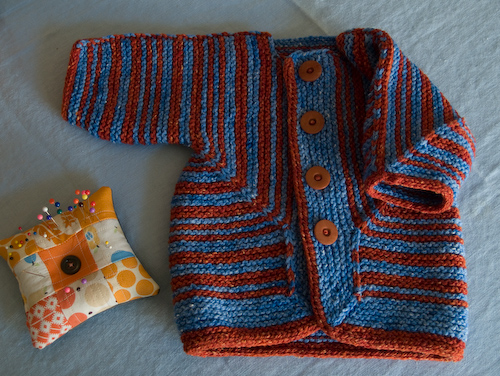
I’ve been a devotee of Elizabeth Zimmermann since the day I discovered her work. Given that I didn’t learn to knit until after her death, I’ve got nothing on the hordes of knitters who have revered her for half a century. In fact, it was just about exactly four years ago that I ran across a dog-eared copy of The Knitter’s Almanac at Powell’s and shortly thereafter launched Zimmermania and began Mr. G’s Fishtrap Aran, which is still one of my most prized accomplishments.  But the first of Elizabeth’s designs that I completed was the Baby Surprise Jacket. I made one for Misa & Morgan’s son that same autumn, and about two years later I made another for their daughter. Both these little jackets have been lovingly passed on to other friends with babies, which delights me and assures me that this design is a true classic destined to be appreciated for as long as we have  wool and sticks to knit it with and babies to bundle into it. So I could hardly let my own spawn weather its first year unSurprised.

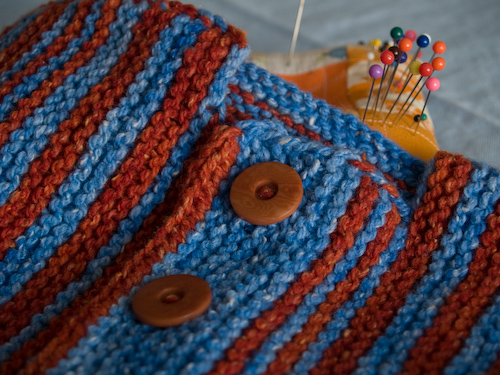
MinnowBSJ1

Orange and blue are kind of a thing for us — Mr. G injected his own aesthetic sense into our wedding by selecting a bright orange tie and socks, and at the time I wasn’t so sure about his choice. Orange seemed weirdly autumnal for a June wedding and didn’t exactly provide any continuity with the blue bridesmaids’ dresses or the ocean backdrop. But I ended up using the tie to bustle my wedding dress so we could have a proper dance, and I’ve been fond of orange and blue together ever since. (And if my grandchild ever decides to make a quilt out of the hopelessly dated but sentimentally valuable clothes we’ve left behind, I hope that orange tie will be in it.)

This orange and this blue are Miss Babs’s Cumberland Sport, hand-dyed on an 80% wool and 20% cotton base from Green Mountain Spinnery. Miss Babs has discontinued the yarn and the remainder of her stock is on sale, which is where that link will take you!* This is good stuff, rustic and tweedy and sturdy and minimally processed, and Miss Babs’s dye process complements the yarn beautifully. I had Sky and French Marigold, one skein of each. I ran out of the Sky just a few garter ridges shy of where I’d hoped to stretch it, but oh well.

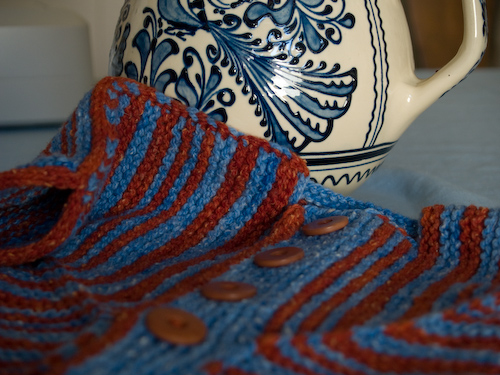
MinnowBSJ2

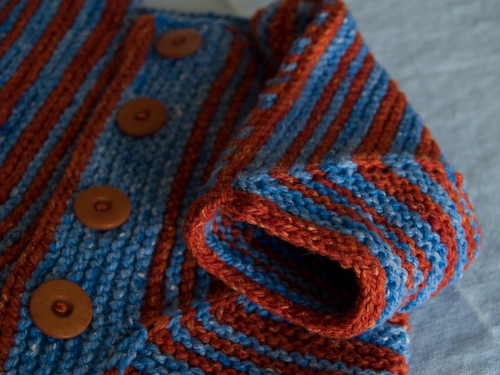
Every time I do a BSJ I try something a little different with the details. Here I opted for a centered decrease that I slipped on the wrong side to create that architectural miter, and I continued the effect by (wrong-side) slipping the stitch between the paired increases on the body portion, too. I wanted i-cord edging in the orange, and remembered having learned from Joyce Williams (at Schoolhouse’s Knitting Camp two years ago) a way of concealing the blips of blue base color that you get from doing an applied i-cord edge in the standard way. But I couldn’t remember just what that was, and I was down at the coast**  and hadn’t brought my notebook. So I used technology. I borrowed my husband’s iPhone to email a cry for help to Jen, which I figured was the best possible move. Not only does Jen epitomize the kind of thorough, curious, experimental-yet-steeped-in-tradition, and encyclopedia-brained knitter that you want to know when you’ve got burning questions about technique, but she was actually AT Knitting Camp in the PRESENCE of Joyce Williams at that very moment. (And yes, I was wild with envy.) Jen sent back these instructions:

From Joyce herself:
(co 2 & slide to right of garment sts)
*K2, sl1, yo, k1, psso [return 3 to left needle]*

It’s the yo that makes it blip less
Hope you’re having a good weekend! Joyce says to tell you hello!
j

Sent from my iPad

(I think I may need one of these iPads at some point.) After a couple of false starts for which I blame third trimester pregnancy brain, I got my i-cord going. But I was still seeing just a wee bit of blue through the orange. So I unvented this variation, which looks a bit like it’s been partially crocheted and therefore isn’t quite as natty as regular i-cord to this knitter’s eye, but totally hides the base color:

CO 2 and slide to the right of the live garment sts. *K2, yo, sl1, k1, pass over yo and slipped st, return 3 sts to left needle and rep from *.

MinnowBSJ3

Try it or stick with Joyce’s way — as Elizabeth would say, “Knitter’s choice!”

I also mucked about with a reinforcement of the traditional yo-k2tog buttonhole, as I’m always bothered by that untidy strand of yarn that occurs on the following row and can later confuse you about which hole you actually want to poke the button through. Here’s what I came up with:

On the return (WS) row, k tog the stitch preceding the buttonhole with the front leg of the yo, but don’t slip the yo off the needle. Bring the yarn forward and over the needle to trace the path of the yo yarn, then carry on knitting as usual. On the next (RS) row, k tog the two yo strands as one st. (Note that this is for garter stitch; if working in stockinet you’d purl rather than knitting on the WS row.)

It seems to create a firmer buttonhole, which can be good if your buttons aren’t large enough to be a nice tight squeeze through the regular kind of hole. Anyway, I like it when knitters share their dabblings, so I thought I’d put some of mine up here.

But enough knitterly minutia. I love this little jacket and I can’t wait to wrestle my baby’s pudgy little arms into its stripey sleeves.

MinnowBSJ4

*I’ve been there ahead of you and stocked up on Pewter and Light Turquoise. Because Minnow’s going to need a Tomten for the winter after this one.

**More on this little getaway next time. Mr. G took some fine pictures in Ecola State Park. You couldn’t have convinced me beforehand that even gentle hiking’s fairly grueling for the nearly-nine-months-pregnant body, but it was well worth being sore and tired and having extra contractions the next day.

Baltic Rose

Published on Tuesday March 2nd, 2010

Good for one Knitting Olympics finisher’s medal:

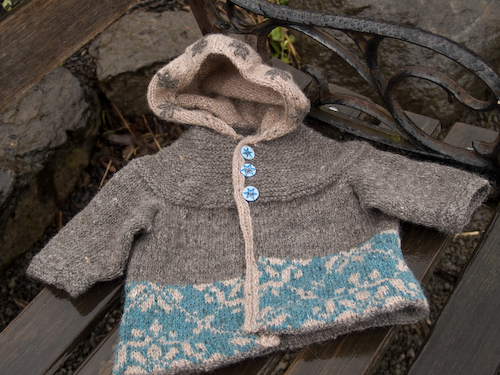
BalticRose

About this lever knitting business: several of you asked why I’d want to learn a whole different way of knitting, and it’s a good question. I am the kind of person who wants to know about this kind of thing just because it exists and because it’s so significant to the history of the craft (knitters who had to work fast enough to earn a living at it knit this way; our more familiar throwing and picking styles emerged from a desire to make the process of knitting look more ladylike).  I can’t yet lever knit effectively enough to make it faster than my usual throwing. But it does, in the mean time, let me use my hands and wrists in a different way, and as I now know from my class with Carson Demers, that’s a good thing. My work is all about using the computer, and between that and my knitting habit I’ll need to be careful if I want to avoid repetitive stress injuries. I was almost the only person in Carson’s class at Madrona who didn’t already have problems in the wrists, elbows, or shoulders, and I want to be able to knit in comfort until I’m dead. So changing up the positions in which I knit is a really good idea.

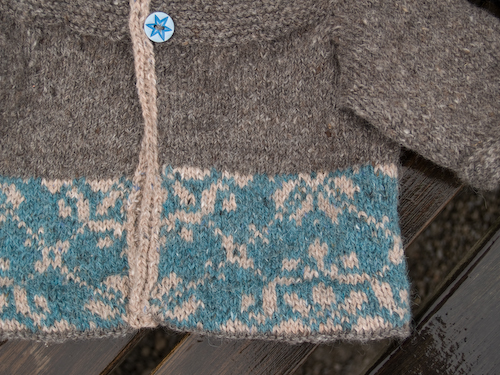
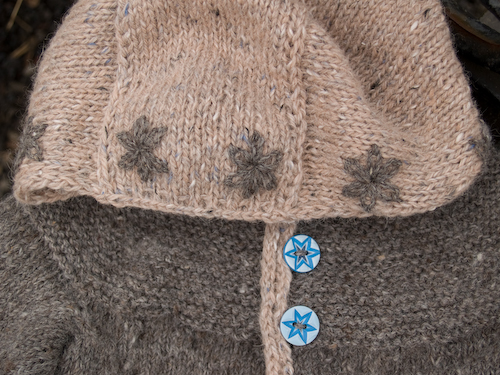
So back to this little practice sweater. I had the one lovely skein of Toots LeBlanc Jacob/Alpaca DK, but I knew it wouldn’t stretch to a whole sweater. I had some Rowan Felted Tweed in the stash that was about the same weight, so I figured I’d add a hem in colorwork. I thought I remembered Lizbeth Upitis’s Latvian Mittens having some nice large botanical motifs, and sure enough I opened the book right to the page with the chart for Graph #53: District Unknown. And I only needed to increase three stitches to fit in three repetitions of the motif.

BalticRose_hem

I only worked half the chart because I didn’t think a long cardigan would be very practical on a three-month-old, but I quite like the sort of wallpaper effect that results.

There was still the problematic neckline to deal with, though. I tried tacking it down a couple of different ways, but I just wasn’t satisfied. A hood seemed like the best solution, so I quickly knit one up in the Felted Tweed. And since I’d already given up on this little cardigan being unisex, I thought I’d use the last yard of the Toots LeBlanc for a little embroidery to match the buttons.

BalticRose_hood

Ta-da! Another little sweater banked against the onslaught of 2010 babies. I really want a whole grown-up sweater’s worth of the Jacob/alpaca. So tweedy. So full of character. Love it.

The sum total (but not really)

Published on Monday February 15th, 2010

Madrona2010

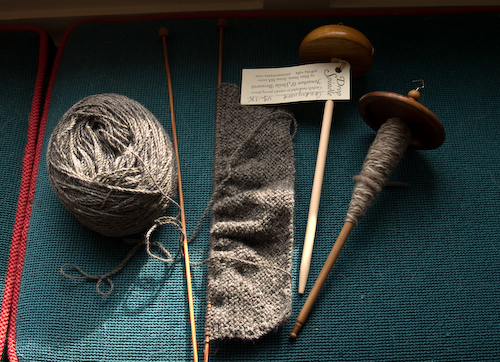
This is everything I accomplished at Madrona. Not a lot to show for myself, is it? On the spindle is a small quantity of really softly spun Cormo and CVM 2-ply, and on that loooooong straight needle is about 20 ridges of garter stitch in really yummy Jacob/alpaca DK from Toots LeBlanc.

But I can now tell you what cop is (the yarn you’ve made that’s wound around the spindle), I can use the drop spindle standing up (a really good idea, as I’ll explain later), I can do a thigh twist to start the spindle (standing on one leg, even), I can kick start it when it’s near the floor, I can fix thick spots in the yarn and do a better join when I need to “edit” a thin spot, I can keep twist out of my draft zone by back-twisting with my right hand just a little bit, and I can ply out of my bra.

Yes, you read that right.

Turns out a good way to ply two or more strands is to wind them together onto a crumpled ball of paper, pop the resulting ball down your cleavage, and wield the drop spindle pulling the strands from between your buttons. If nothing else, this is certainly more eye-catching than my old method using the chopstick apertures in my two rice bowls.

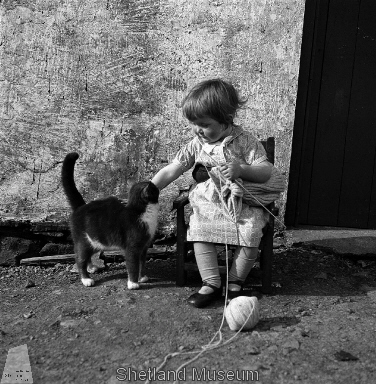
And I’m darn proud of my 40 rows of garter stitch, because I achieved them by lever knitting. That means the technique for knitting that relies on one needle being fixed under your arm, in a belt or sheath, or wherever you can comfortably plant it and then bringing the knitting to the fixed needle tip rather than fishing after it. I’ve read about it — this is how the Shetland knitters made their beautiful jumpers on long, long double-pointed needles before circulars were invented — and now I know (in theory, at least) how to do it. It feels just as clumsy as whatever knitting method you use felt when you first tried it. Stephanie assured us we would all suck, and she was perfectly right. This tiny girl is clearly beating me around the block:

Shetlandgirl

This photo is from the Shetland Museum Archives and is proof I will always reach for in the future if I need to argue that small children are capable of intellectual focus and remarkable dexterity… and of not poking their eyes out with tools. This tot’s grasping a set of needles that are longer than her legs, and she’s already knit half a sweater with them. Awesome.

Anyway, Stephanie challenged us to practice lever knitting just a little each day for 30 days. And since I can’t back down from a challenge, I vowed I’d lever knit a baby sweater in that time. Hence my 20+ ridges. Which I’m going to add to right now while I watch the men’s downhill. Next time I’ll tell you about my final Madrona class, Knitting Happily Ever After.

The technical bits

Published on Tuesday March 20th, 2007

I haven’t forgotten that I promised some more construction details for the Fishtrap Aran. Mr. Garter has been wearing it regularly (I think he slept in it one night when he crashed on his parents’ couch after a late-night work session with his dad) – so regularly, in fact, that he’s already fuzzing up the collar lining. It didn’t begin to occur to me that the mature gentlemen among us grow bristly little hairs out of their necks and chins that have the same effect on soft wool yarns as wire brushes. Curses! Mr. Garter is under orders to shave twice a day if he wants to zip his Fishtrap all the way up. I’m partly kidding, but he gave me this innocent look and said, “Well, isn’t that why you put a liner in it? So you could take it out and knit me a new one whenever I need it?” I think I hardly need to describe the dirty look he received in return. Here’s the collar lining all pretty and new:

FAconstruct_collar.jpg
For those of you wondering about the zipper insertion and finishing technicalities, here’s some more detail. I began with a crochet steek. There seem to be several different methods floating around on the internet with excellent tutorials, but I did it the simple way Jen taught me.

1) Leave an extra allowance of three stitches for the steek when you begin the knitting. Twist the stitches on either side of this column for a neat, crisp edge.

2) Weave a line of bright waste yarn down the center of the stitch you’re going to cut – the middle column of the three.

3) Here’s a diagram of your three stitch columns:

\/ \|/ \/
\/ \|/ \/
\/ \|/ \/
123456

The numbers correspond to each side of the stockinet V’s. The vertical lines down the center are your waste yarn, marking the steek line. This is where you’ll cut.

4) Using a finer weight yarn that matches the main sweater yarn (I used Jamieson Shetland Spindrift in Moorit, which matched the Ballybrae Blainin Tweed beautifully), crochet a single chain line by inserting the hook under 5 & 4, drawing through a loop, inserting the hook under 5 & 4 in the next row down, etc. Then chain together the 2’s & 3’s in the same manner up the other side. For an armhole steek, you’ll work a continuous chain down one side, under the bottom of your steek line, and up the other side. For full cardiganization, you’ll want to let your chain trail off to either side at the tops and bottoms for a few extra stitches to secure your work. Later you can unpick these extra stitches and weave in the resulting end. At any rate, you never want to cut across your crochet chain.

5) Cut along the line between 3 & 4, which you marked with your waste yarn, pulling the waste yarn out as you go along. It’s really easy to see the little horizontal bars to cut if you’ve done your crocheting properly – you’d have to work at it to cut in the wrong place.

6) The cut edges will naturally roll inside, and with some handy steam action from an iron, you can easily persuade them to stay there. You want the crease to leave your neatly twisted edge stitches, well, right on the edge.

For the armholes, you’ll want to tack down the cut edges on the inside in the same yarn you used for the crochet job. I used a herringbone stitch per EZ’s instructions – very tidy indeed. As you can go along, you can tuck in any raggedy cut strands that might be rearing their heads, and the herringbone stitch will batten them into place, never to worry you again. Skim the thread or light yarn through the body stitches so it won’t be visible from the outside of the sweater.

Now sew in your sleeves, attaching them to the running bars between the twisted edge stitches and the crocheted edge. I promise, it will be obvious what I mean. This leaves your twisted stitches as a neat divider between sleeve and body.

Time to sew in your zipper. For the love of Pete, make sure it’s the right length. Insert yourself or your subject into the sweater and double-check your zipper length. Begin by pinning the zipper in place. I used these nifty two-prong pins my mother-in-law gave me. I have no idea what they’re actually called, but they worked perfectly. Make sure the steeked edge stays rolled under as you pin. With thread that matches the sweater yarn, whipstitch the 1’s and 6’s to the zipper about half a centimeter from the teeth. Use small stitches, or the zipper won’t feel firmly attached to the sweater fabric and may not stand up to manly tugging. (I wouldn’t want to test it, would you?) The whole zipper sewing process is easiest if you unzip the portion you’re working on.

Once the zipper is in, you can sew in ribbon facings to cover the back of the zipper, or you can do as I did and knit contrasting facings. A six-stitch stockinet strip worked well for me. Again, when sewing it in, skim the needle through the surface of the sweater fabric, but do not penetrate or the stitches will show through. Last of all, work two lengths of i-cord in the sweater yarn – I made a four-stitch cord – to conceal the zipper from the outside. This also has the virtue of covering any ugliness that may have happened in the whipstitching.

Pictures. Want pictures? Of course you do.

FAconstruct_sleevejoin.jpg FAconstruct_armhole2.jpg FAconstruct_armhole.jpg

FAconstruct_zipper.jpg FAconstruct_facing.jpg FAconstruct_zipper2.jpg

Clockwise from upper left: the sleeve join, right side; inside of armhole steek showing herringbone stitch; different view of armhole steek; zipper, showing slatternly whipstitch attachment; zipper facing on the inside; i-cord concealing zipper from the outside.

I know it’s hard to see the herringbone stitch. If this were a proper tutorial, I’d have done it in a bright color so you could see the thread. But I was going for tidy and unobtrusive.

I’m intrigued by the sculptural and textural properties of this sweater, especially when it’s all crumpled and inside-out. The Fishtrap pattern is a freaking piece of art. Elizabeth Zimmermann sure knew what she was doing.